
Get Your Free Copies — Peter’s IRS Survival Guide & Non-Filer’s Guide
Written by Peter Kici, Enrolled Agent & Marine Corps Veteran. Real strategies. Real cases. No fluff.
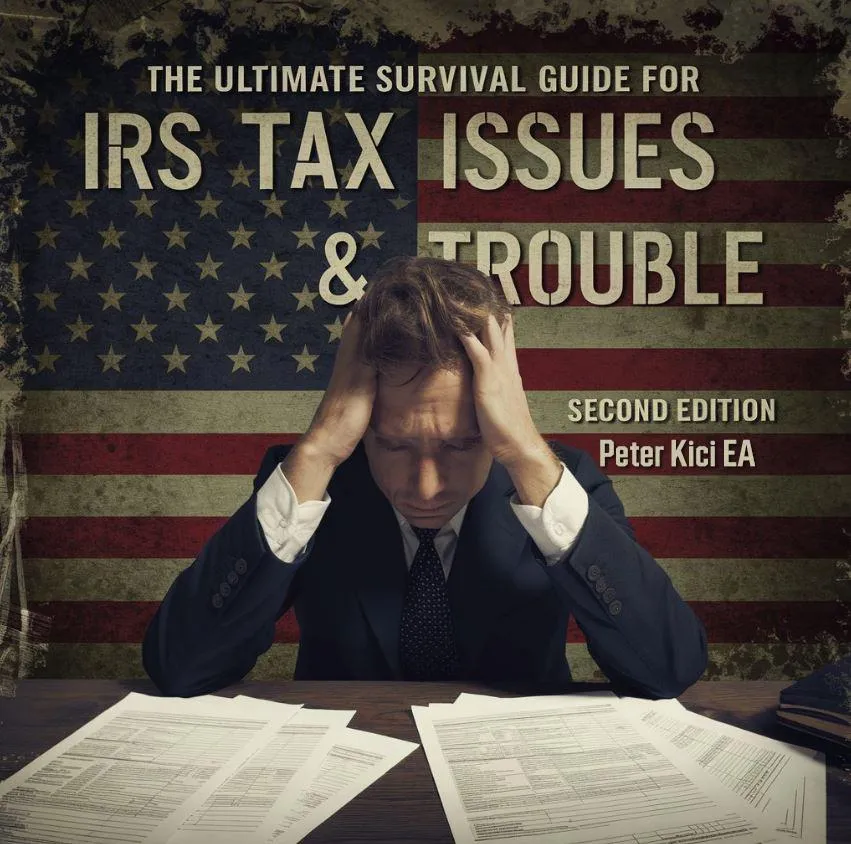
Book 1 — The Ultimate Survival Guide for IRS Tax Issues & Trouble
- How to respond to an IRS notice without panicking — and what not to do
- Your real options when you owe back taxes — installment plans, OIC, and more
- How to stop a wage garnishment or bank levy before it happens
- What IRS collection actions can and cannot do to you legally
- How to handle unfiled tax returns without making things worse
- Proven strategies from real cases Peter has resolved
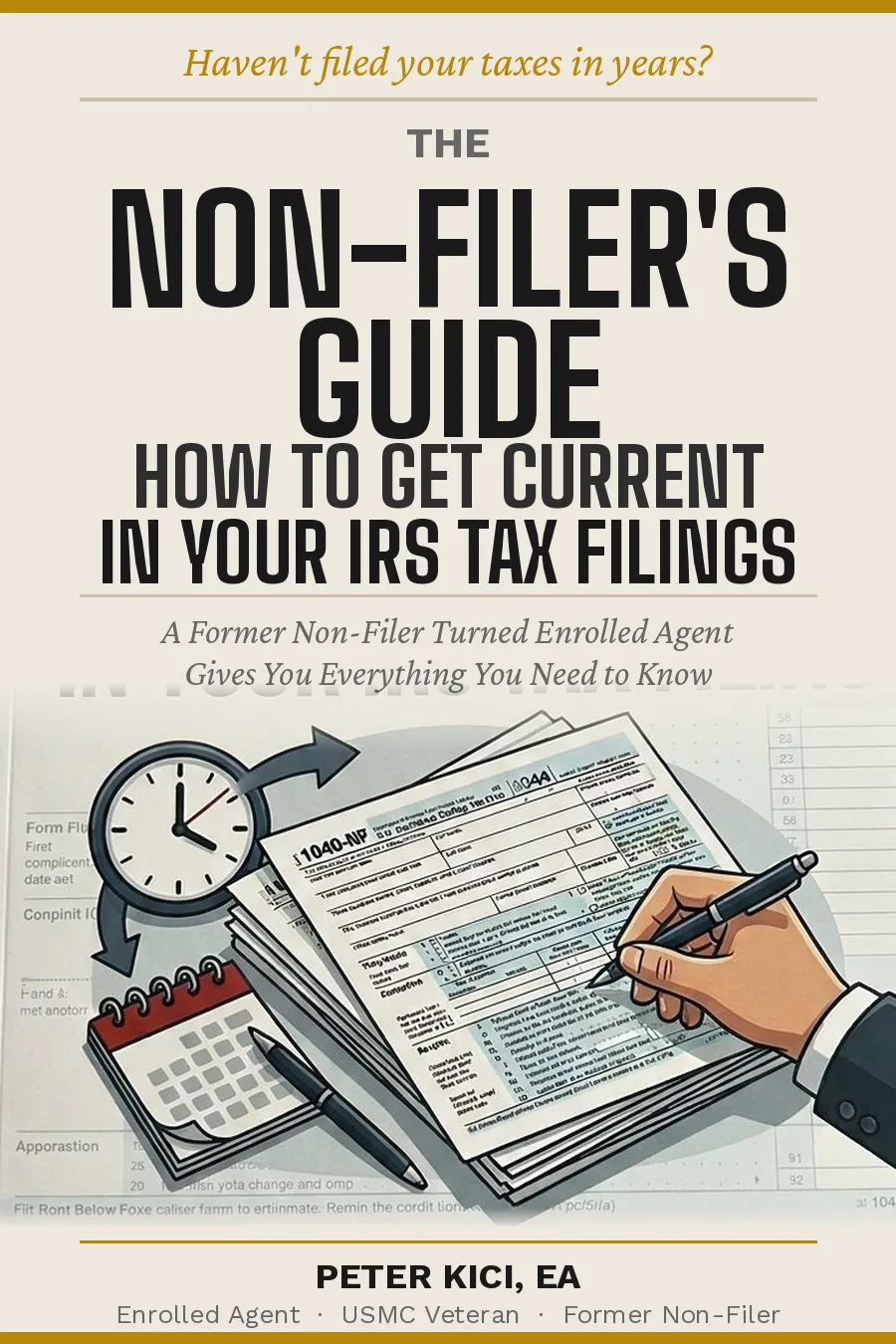
Book 2 — The Non-Filer’s Guide: How to Get Current in Your IRS Tax Filings
- How to get current with the IRS — even if you haven’t filed in years
- What to do when the IRS files a return for you — it usually shows more tax than you really owe
- How to piece your records back together when documents don’t exist
- Your options when you owe back taxes and can’t pay
- How to stop garnishments, levies, and liens triggered by unfiled returns
- Proven strategies from real non-filer cases Peter has resolved

What Is Actually Inside These Guides
Most people who owe the IRS are not confused about the fact that they owe. They are confused about what comes next — which letter matters, which deadline is real, and which of the options they have read about online actually applies to them. Both guides are written to answer that in plain English, without the sales pitch.
The Ultimate Survival Guide for IRS Tax Issues & Trouble
This one walks through the IRS collection process in the order you will actually experience it: the first balance-due notice, the reminders that follow, the final notice of intent to levy, and the point at which a wage garnishment or bank levy becomes possible. It explains what each notice means, how much time the notice actually gives you, and what the realistic paths are at each stage — an installment agreement, an offer in compromise, currently not collectible status, or penalty relief — along with the conditions that determine whether any of them is available in a given case.
The Non-Filer’s Guide: How to Get Current in Your IRS Tax Filings
This one covers a narrower and more urgent problem: what to do when returns have not been filed for one year, or for ten. It explains the substitute for return — the return the IRS prepares on your behalf when you do not file, built from the income reported to them and none of your deductions — and why the balance it produces is usually larger than what you would have owed on a return you filed yourself. It also covers how to rebuild records that no longer exist, how far back the IRS generally expects a taxpayer to go, and how filing interacts with collection activity that is already in motion.
Neither guide is a substitute for advice on your own facts, and neither one can tell you what the IRS will do in your case. They exist to get you oriented, so that when we do talk about possible debt relief, you already know what the words mean and what the process looks like.
Who These Guides Are For
- Anyone holding an IRS notice who is not sure whether it is routine or serious
- Taxpayers who owe back taxes and cannot pay the balance in full
- People with unfiled returns — one year or many — who want to get current without making the situation worse
- Self-employed workers, freelancers, and 1099 contractors carrying a balance from underpaid estimated taxes
- Small business owners who have fallen behind on payroll taxes and Form 941 deposits
- Anyone facing a wage garnishment, a bank levy, or a federal tax lien
- Spouses and former spouses who believe a balance belongs to the other person
- Family members trying to help a parent or relative sort out an IRS problem
If you are in Central Florida — Orlando, Seminole County, Lake County, Osceola County — that is the area I work in every day. But IRS collection is federal, and everything in these guides applies wherever you happen to live.
What Happens After You Download
You enter your email address and the guide arrives right away as a PDF. There is no cost, no card, and nothing else you have to do to read it.
Over the following days you will also get a short series of emails from me covering the questions readers ask most often — how the collection timeline actually runs, what the IRS looks at when it reviews an offer in compromise, and which documents are worth gathering before any resolution attempt starts. You can unsubscribe from any one of them, and the guide stays yours either way.
If at some point you want a professional set of eyes on your own situation, you can book a free consultation with me directly. That call is a conversation, not a presentation. I look at what the IRS actually has on file for you, walk you through which options are realistically on the table, and tell you plainly if you do not need to hire anybody at all.
What I Do When a Case Becomes a Case
If we do move forward together, the first step is almost always the same. I file a Form 2848 Power of Attorney and pull your IRS transcripts, so that we are both working from the IRS record instead of from memory or guesswork. That single step usually answers half the open questions: what has been assessed, what has been filed, what has not, how much of it is penalty and interest, and how much time is left on the collection clock.
What comes after that depends entirely on the facts — your filing history, the size of the balance, the assessment dates, your income and assets, and whatever collection activity is already underway. I am an Enrolled Agent, a tax practitioner licensed by the U.S. Department of the Treasury with unlimited rights to represent taxpayers before the IRS in all fifty states. I cannot promise you a particular outcome, and any firm that does is telling you something nobody is in a position to know. What I can do is tell you what the rules allow in your circumstances, what the process will look like, and what it will take from you.
IRS back taxes and tax debt relief options →
Help with unfiled tax returns →
IRS offer in compromise and tax debt settlement →
IRS payment plans and installment agreements →
Stop an IRS wage garnishment →
Stop an IRS bank levy or asset seizure →
Currently not collectible and financial hardship →
IRS penalty abatement relief →
Questions People Ask Before They Download
Is the guide really free?
Yes. Both guides are free PDFs. There is no charge, no credit card, and no obligation to hire me or anyone else after you read them.
Does downloading it put me on some kind of IRS list?
No. This is my own website and my own email list. It is not connected to the IRS, and downloading a guide tells the IRS nothing about you.
Which guide should I read first?
If you have filed your returns and simply owe money, start with the Survival Guide. If there are years you never filed at all, start with the Non-Filer’s Guide — getting into filing compliance normally has to happen before any resolution option can be considered. Plenty of people need both.
I have not filed in years. Is it too late to fix?
It is not too late. Unfiled returns are one of the most common situations I see, and they can be addressed. The guide explains how the process generally works and what to expect. What the outcome looks like depends on your specific facts.
Can you help me if I do not live in Florida?
Yes. Enrolled Agents are licensed federally, not by state, so I can represent taxpayers before the IRS anywhere in the country. Central Florida is simply where most of my clients happen to be.
How long does it take to resolve an IRS balance?
It varies widely. Some matters, like a straightforward installment agreement, can move quickly. Others, like an offer in compromise, involve a long IRS review and can run many months. Anyone who quotes you a firm timeline before reviewing your transcripts is guessing.
What if I genuinely cannot pay anything right now?
There is a status called currently not collectible for taxpayers whose finances leave nothing available to pay. It is not forgiveness and it is not permanent — the IRS reviews it periodically and the balance continues to accrue interest — but it can pause active collection. Whether it applies depends on the financial information the IRS requires.
Do I have to hire you after I download?
No. A lot of people read the guide, handle it themselves, and I never hear from them. That is a fine outcome. The guide is written to be genuinely useful on its own.
Please note: These guides are general educational information about IRS procedure, not tax advice for your situation, and reading them does not create a client relationship. Tax outcomes depend on individual facts, and no result can be promised in advance. Tax Debt Relief Group is not a law firm; Peter Kici is an Enrolled Agent, a federally licensed tax practitioner, not an attorney.